One of the most pervasive (and unfounded) arguments against Loki’s worship in American Heathenry, is that we have no physical or written evidence to suggest he was ever worshipped in the past. This has often been used as “proof” that he was reviled in Scandinavia, since he was seemingly so hated that nobody would want to worship Loki or name anything after him. However, there is a similar lack of evidence for the worship of Heimdallr, Sif, and many more of the Norse deities. It seems that Loki has been singled out in this long list of deities without evidence of an organized cult, in an attempt to defend his image as a malignant figure in modern Heathenry. However, no hard evidence that Loki was absolutely reviled has ever been presented either, and the idea that Loki never had place-names or people named after him has become such a parroted statement in modern Heathenry, that many people have no longer bothered to question it. For the record, the statement that Loki never had anything or anyone named after him is provably false. Despite these criticisms, I have researched what I consider to be valid evidence to suggest that Loki was an object of worship in Scandinavia, and at the very least was an object of affection as a folk-hero in at least one country.
Útgarða-Loki
The Gesta Danorum (“Deeds of the Danes”) was written in the early 13th century by the Danish priest and historian, Saxo Grammaticus. Saxo’s work is composed of 16 books that chart the history of Denmark from prehistoric times to the late 12th century. The object of the book was largely to glorify the Danes.1 Scholars such as Axel Olrik have suggested that Saxo received his knowledge of Scandinavian mythology and folklore largely from Norwegian sources, and much of his information may have been collected by an Icelander who traveled the Norwegian coast.2
Because Snorri and Saxo were writing at approximately the same time, scholars are unsure which one of them should be considered the earliest collection of Norse mythology. It is possible that Snorri was following a purely Icelandic tradition, whereas Saxo primarily relied on sources from continental Scandinavia. It is notable that Loki appears nowhere in Saxo’s account of Baldr’s death, which might reflect the beliefs of Denmark.3
Though both Snorri and Saxo should be regarded as sources for the study of Heathen mythology, Saxo is often overlooked by modern Heathens. Part of the reason for this may be because Snorri is both more easily accessible and more entertaining to read. Perhaps it is for this reason that the strange interlude I’ll be examining first has never been mentioned by modern Heathens or Lokeans in discussions about Loki.
Saxo’s Gesta Danorum provides us with a familiar, yet at the same time unusual image of Loki. In part II of Book VIII, it becomes evident that King Gorm of Denmark is a fervent worshipper of a god he refers to as Útgarða-Loki. According to Saxo, while King Gorm was making a voyage, his ship was buffeted by bad weather and few of his men survived. Gorm’s men began offering sacrifices to appease a multitude of gods, but Gorm prayed to his favored deity, Útgarða-Loki, and received the fair weather he had prayed for.
“…he was tossed by bad weather; his men perished of hunger, and but few survived, so that he began to feel awe in his heart, and fell to making vows to heaven, thinking the gods alone could help him in his extreme need. At last the others besought sundry powers among the gods, and thought they ought to sacrifice to the majesty of diverse deities; but the king, offering both vows and peace offerings to Utgarda-Loki, obtained that fair season of weather for which he prayed.”4
The king finally returned home, took a queen from Sweden, and resigned himself to live a peaceful life from then on. However, near the end of his life, we learn that certain unnamed men persuaded him that his soul was immortal, and he wanted to learn what kind of afterlife he would receive as a result of his zealous worship of Útgarða-Loki. The men in question advised the king to seek out a heavenly oracle, and claimed that Útgarða-Loki must be found and appeased in order to gain a satisfactory answer from him. The enemies of a hero named Thorkill (whose name appears to be derivative of the god Þórr) volunteered him to go on the mission to find Útgarða-Loki, and ironically were sent with Thorkill on the perilous journey.5
Their ship sailed into a sunless place, and after suffering many hardships and nearly starving to death, they saw the twinkle of a fire in the distance. When they reached shore, they came to a cavern guarded by two giants who were feeding the fire, and one of them gave Thorkill directions to reach Útgarða-Loki’s cave. After four days of rowing, Thorkill finally reached the cave of Útgarða-Loki, and found him in a position that closely resembles Snorri’s treatment of Loki in Gylfaginning:
“Then he made others bear a light before him and stooped his body through the narrow jaws of the cavern, where he beheld a number of iron seats among a swarm of gliding serpents. Next there met his eye a sluggish mass of water gently flowing over a sandy bottom. He crossed this and approached a cavern which sloped somewhat more steeply. Again, after this, a foul and gloomy room was disclosed to the visitors, wherein they saw Utgarda-Loki, laden hand and foot with enormous chains. Each of his reeking hairs was as large and stiff as a spear of cornel. Thorkill (his companions lending a hand), in order that his deeds might gain more credit, plucked one of these from the chin of Utgarda-Loki, who suffered it. Straightway such a noisome smell reached the bystanders that they could not breathe without stopping their noses with their mantles. They could scarcely make their way out, and were bespattered by the snakes which darted at them on every side.Only five of Thorkill’s company embarked with their captain: the poison killed the rest…”6
In Saxo’s Gesta Danorum there is no mention of Loki, but only of Útgarða-Loki, who bears the same name as the mysterious giant Útgarða-Loki from Snorri’s Gylfaginning. However, because Útgarða-Loki is depicted as bound by chains and surrounded by venomous snakes, it is possible that this figure is actually the same Loki as the one in the Eddas, with a slightly different title. It should however be noted that where Snorri places Loki in an imprisoned state because he claims him to be the murderer of Balder, we are given no explanation from Saxo as to why Útgarða-Loki is in his predicament. Scholars such as Oliver Elton and Anna Birgitta Rooth are in agreement that the Útgarða-Loki of Saxo’s account is the same as Loki Laufeyjarson from Snorri’s account. With this in mind, the rest of the account becomes particularly interesting.
Thorkill and his men returned home with the hair plucked from Útgarða-Loki’s face. Upon hearing Thorkill’s account of events, the king’s reaction was surprising.
“He listened eagerly to his recital of everything, till at last, when his own god was named, he could not endure him to be unfavorably judged. For he could not bear to hear Utgarda-Loki reproached with filthiness, and so resented his shameful misfortunes, that his very life could not brook such words, and he yielded it up in the midst of Thorkill’s narrative. Thus, whilst he was so zealous in the worship of a false god, he came to find where the true prison of sorrows really was.”7
This passage is significant for a variety of reasons. First of all, it is obvious that King Gorm had a special devotion to Útgarða-Loki (i.e. Loki?), and when he heard Thorkill’s account he was so upset by the description of his god’s circumstances that he died of grief on the spot. It is also notable that a story of a bound Útgarða-Loki was news to King Gorm, and that apparently he had never heard of this development before. This seems unusual if we are to believe that there was a widespread belief that Loki (or Útgarða-Loki) was imprisoned underground. Thorkill is obviously using this tale to shed an unfavorable light on Gorm’s favorite god, which implies that Útgarða-Loki did not have an unfavorable character to begin with. It is notable that Thorkill is a Christian hero in Saxo’s account, so it isn’t unimaginable that this story demonstrates the negative light that was cast upon Útgarða-Loki (Loki?) in particular with the coming of Christianity. I am also inclined to believe that Saxo didn’t completely fabricate the devotion held by the Danish monarchy to Útgarða-Loki. Útgarða-Loki seems an unlikely candidate for a king’s devotion, and defaming a better known god such as Óðinn or Þórr in this situation would have been more logical if the story were entirely fabricated.
As I have already mentioned, Saxo and Snorri were writing during the same century and it is difficult to tell which of their accounts was written first. This leaves the reader to choose between two logical conclusions:
1. Saxo was not writing about Loki, but was writing about Útgarðr-Loki, who is a separate figure that also appears in Snorri’s account in Gylfaginning. If you agree with this theory, then there is a reasonable doubt that it was Útgarðr-Loki, not Loki Laufeyjarson, who traditionally came to be bound underground, and Snorri either botched his account, purposefully changed it in order to devise a more compelling and cohesive story of Balder’s death and how it tied into the end of the world as imagined in Völuspá; or perhaps the identity of the bound figure differed depending on the region. This would also mean that the obscure giant from Snorri’s account was actually considered a god and an object of worship in Denmark.2. Saxo was writing about Loki Laufeyjarson and referring to him as Útgarða-Loki. This would mean that there is a record of Loki being worshipped in Denmark (by royalty, no less), which invalidates claims that Loki was never worshiped in antiquity. Due to King Gorm’s surprise at Thorkill’s account, it is also possible that the bound, tortured Loki was a myth which was not originally known by the Danes.
I am more inclined to agree with the second theory, and believe that this account in the Gesta Danorum is an intriguing piece of evidence for Loki’s worship in Heathen times. The fact that he was being worshipped by a king could also signify that Loki was at one time held in much higher esteem than is usually believed, and perhaps he even possessed a cult of his own.
The Nordendorf Fibula
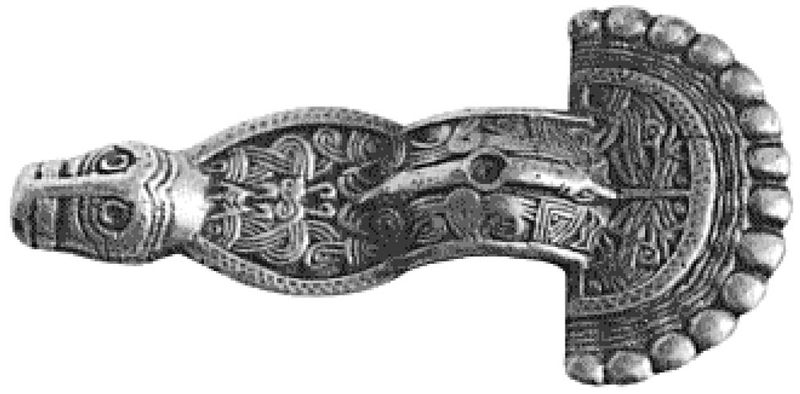 (Nordendorf fibula, public domain image found at Wikimedia Commons: http://commons.wikimedia.org/wiki/File:Nordendorf-brooch.jpg)
That there may be evidence for Loki’s worship in Germany has been suggested by the discovery of the Nordendorf fibula (a gilded silver brooch found in Nordendorf, Germany that dates to the beginning of the 7th century). The fibula’s inscription reads:
logaþorewodanwigiþonar
(Then, at a 180 degree angle from this inscription):
awaleubwini8
The second and third names on this inscription are self explanatory. “Woden” is the god (aka, Óðinn), while Wigiþonar has been translated to mean “Battle-Þórr”. The first god name has been interpreted by some as an alternative (and perhaps older) version of the name Lóður/Loki. According to Simek, the name Logaþore may be connected to the Old English words: logþor, logþer, logeþer and logðor, all which imply “malicious”, and could be tied to Loki in his trickster guise9. Loki is also a likely suspect for identification with Logaþor, in that he is the only god that appears as the traveling companion of both Óðinn and Þórr.
The last part of the fibula inscription (awaleubwini) is comprised of the female name “Awa” and the male name “Leubwini”, and it is speculated that the purpose of the inscription was a magical one: the three gods are being called upon to bring happiness to the man and the woman10.
A charm that may bear a resemblance to the Nordendorf Fibula was recorded in the 19thcentury by a clergyman from Lincolnshire, England, who supposedly heard it spoken by an old countrywoman as a boy. This alleged charm is a more enigmatic source that also places Loki, Óðinn and Þórr together in a triad for a blessing:
“Thrice I smites with Holy Crock,
With the mell [hammer] I thrice do knock,
One for god, one for Wod,
And one for Lok.”11
This seems to be a reference to Óðinn, Loki, and Þórr (possibly the god of the hammer). However, the odds that the clergyman correctly remembered this obscure poem that he heard by chance in childhood are rather small. We cannot be certain this small piece of folklore is authentic, but at the very least, we can conclude that even in the 19thcentury, there remained a link between Óðinn, Þórr, and Loki in the minds of the English populace, and Loki was included in prayers for blessings.
Loki in names of people and places
Many sacred locations in Northern Europe bear the names of gods and goddesses. It is also common for god names to appear as elements in the names of common people, such as “Þórr” as part of many names in Iceland. Many modern Heathens have claimed that Loki doesn’t have any historical people or geographical sites named after him, which apparently proves that he was reviled in his native countries. However, this argument is hardly viable, as there actually were people, places, and even stars that were named after Loki.
Axel Olrik provides a list of Scandinavian names which he believes contain Loki’s name in Loke in the Younger Tradition. In 12th century Northumberland, England, there is a record of a man named Locchi. In Småland, Sweden, Locke has been preserved as a hereditary surname. On a rune stone in Uppland, Sweden, the name “Luki” (Loki?) appears. It has also been traced to the place names Lockbol, Luckabol, Lockesta, and Locastum.11 Jacob Grimm also tells us that there is a giant’s grave in Vestergötland, Sweden, named Lokehall.12
There was also a settler in Norway called Þórbjørn loki, and a man called Þórðr loki.13Another name for Loki also prominently appears in the biography of Snorri Sturluson. Snorri’s foster-father was named Jón Loptsson (“son of Lopt”), Lopt being one of the most prominent bynames for Loki. Ironically, Lopt, Jón’s father, was a priest from a well-to-do family. It isn’t hard to imagine that at least someone from heathen Scandinavia was granted the name Lopt or Loki. Loki was considered to be the most cunning god of the Norse pantheon, and surely at one time it would have been considered auspicious for a clever man to bear his name.
Though it is a common statement in the Heathen community that Loki has no geographical place names within Scandinavia, there is at least one in the Faroe Islands called Lokkafelli (Loki’s Fell). It is noteworthy that the Faroe Islands are also the country of origin for the folk tale Lokka táttur (or “Loki’s Tale”), which was first recorded in the late 18th century. Loki stars as the hero of this story, who is the only one who is clever enough to rescue a farmer’s son from a giant when Óðinn, Hönir, and Loki are all petitioned to help him. Because of the lateness and obscurity of this poem it seems to have been largely ignored or overlooked in the Heathen community, but it seems uncharacteristic that a mythological figure who was traditionally reviled in Scandinavia would possess a story that casts them as an clever hero. That Loki has a landmark in the Faroe Islands named after him could also demonstrate that Loki received some degree of affection from this populace in particular.
The most famous landmark from heathen Scandinavia that bears Loki’s name is Sirius, the “Dog Star”, was known in Scandinavia as Lokabrenna (“Loki’s Torch”).14 According to the Spanish Aarab At-Tatuschi, this star was an object of worship to the town of Schleswig (Hedeby) in Denmark15. Sirius became known as the Dog Star in Ancient Greece and Rome, as it first appeared on the horizon during what they called the “dog days” of summer. These were the hottest days of summer (falling between early July and early September in the Northern Hemisphere) and the bright star’s close proximity to the sun at dawn was believed to be responsible for the heat. It is thus appropriate that this star was regarded to be the “torch” of the fiery Loki (and before you ask, no, Loki has nothing to do with dogs).
It is interesting that in Denmark, the location of Útgarða-Loki’s worship according to Saxo, there is early testimony for the star Sirius having been worshipped by the Danes.
Conclusion
Hopefully I have been able to demonstrate that the idea that there is no evidence of Loki-reverence in Scandinavia is little more than a Heathen urban legend. It could be assumed that the theory that Loki is and was a reviled figure has been defended in order to uphold the most popular mythic narrative within modern Heathenry: that of Snorri Sturluson. The insistence that a lack of evidence for an organized cult of Loki somehow proves that he was a hated figure is likewise pure speculation, and can be categorized more as a popular, modern UPG than as a proven fact.
Bibliography:
Saxo Grammaticus. The Danish History of Saxo Grammaticus. Tr. Oliver Elton. Forgotten Books, 2008
H.R. Ellis Davidson. Gods and Myths of Northern Europe. Penguin Books, 1990
Jacob Grimm. Teutonic Mythology: Volume One. Tr. Stallybrass, James Steven. Dover Publications, Inc., NY, 1966
Axel Olrik. Loke in Younger Tradition. Tr. Eli Anker. Saertryk af Danske Studier 1909. http://www.northvegr.org/secondary%20sources/folklore%20and%20fairy%20tales/loke%20in%20younger%20tradion/index.html
Rudolf Simek. Dictionary of Northern Mythology. D.S Brewer, Cambridge, 2007
Consulate General of Denmark in New York. Factsheet. http://web.archive.org/web/20060113013845/http://www.denmark.org/about_denmark/factsheets_articles/factsheets_vikings.html
Endnotes:
1Turville-Petre, E.O.G. Myth and Religion of the North. 23
2Ibid, 29
3Ibid, 33
5Ibid, 333
6Ibid, 335
7Ibid, 336
9Ibid, 191
10Ibid, 236
15Consulate General of Denmark in New York. Factsheet. http://web.archive.org/web/20060113013845/http://www.denmark.org/about_denmark/factsheets_articles/factsheets_vikings.html.


